


2025 Chevrolet Blazer vs Blazer EV: What’s Different? What’s the Same?
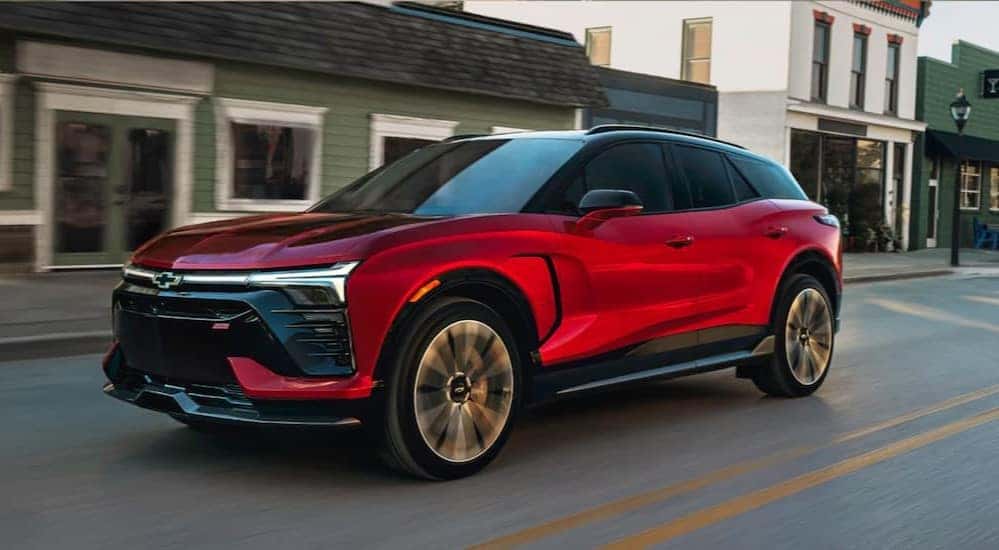
It used to be that when looking at Chevy’s lineup, you’d see one vehicle called the Blazer, another SUV called the Equinox, and a truck named the Silverado. Nowadays, the lineup is expanded, and some of Chevy’s most popular models have had a breath of fresh air pumped into them, not by updating existing cars but by releasing electric versions of them. The first of these was the Chevy Blazer EV, which is the BEV variant of the beloved Blazer. Both SUVs have the Blazer moniker, so they must be similar, right? Yes, but mostly no. Let’s explain.
The Electric Elephant in the Room
Let’s start with the easiest one to spot. The Blazer EV runs on electricity instead of traditional gasoline, which the Chevy Blazer runs on. Both SUVs will drive on the same roads to get you to the same destination, but what’s happening under the hood is wholly different. The 2025 Blazer is powered by a turbocharged 2.0L I-4 or a 3.6L V6 engine—both are paired with a nine-speed automatic transmission.
The Blazer EV’s performance comes from blending strong electric motors with large batteries. Four powertrains are available for the 2025 Blazer EV. An 85 kWh battery with one or two motors is standard, but you can upgrade to a larger 102 kWh battery, also with either one or two motors—the latter is exclusive to the top-end SS trim.
Being an EV, the 2025 Blazer EV doesn’t have a transmission. Instead, the electric motors drive the wheels directly. That means you’re accelerating in one continuous motion with no interruptions like you’d get with a traditional transmission when it shifts gears. Let’s break the powertrain details down further into two categories: performance and efficiency.
Performance
The base powertrains of the Blazer and Blazer EV are remarkably similar. The turbocharged 2.0L I-4 engine in the 2025 Blazer produces 228 hp and 258 lb-ft of torque against the Blazer EV’s 220 hp and 243 lb-ft of torque. However, upgrading to all-wheel drive gives the Blazer EV 300 hp and 355 lb-ft of torque. Still, for the price and size of its powertrain, the gas-powered 2.0L Blazer is exceptional, and it has a higher maximum towing capacity of 3,250 lbs against the Blazer EV’s base powertrain’s 1,500 lbs.
The optional 3.6 V6 engine provides a hearty performance increase. Although the V6 engine is the pricier option, it remains cheaper than the Blazer EV. The 3.6L V6 engine produces 308 hp and 270 lb-ft of torque, and the maximum towing capacity of 4,500 lbs is 38% higher than the base powertrain. The V6 engine also has more horsepower than the base dual-motor powertrain in the 2025 Blazer EV.
Setting aside the base 85 kWh battery for the optional 102 kWh battery is a great idea, and if you purchase the SS trim, there’s no escaping the incredible performance brought on by the additional motor. With the single motor configuration in the RS trim, the 102 kWh battery helps the Blazer EV produce 365 hp and 325 lb-ft of torque. Although the torque output is slightly less than the base dual-motor powertrain, the 102 kWh battery helps the 2025 Blazer EV achieve its maximum towing capacity of 3,500 lbs. Adding the extra motor by purchasing the SS trim massively boosts the output, with 595 hp and 645 lb-ft of torque providing incredible performance.
Efficiency
You can’t mention the Blazer and Blazer EV without discussing what will be the wildest change for those who have never owned a BEV in the past: charging. The Blazer and its traditional gasoline-powered engine are impressively fuel-efficient, and the large fuel tank means gas station trips will be minimized if you’re the type to fill your tank to the top. In FWD models, the 2025 Blazer has a 19.4-gallon fuel tank, which is increased to 21.7 gallons in the AWD models.
With the base powertrain, the 2025 Blazer earns EPA-estimated ratings of 22 MPG in the city, 29 MPG on the highway, and 25 MPG combined. This equates to around 485 miles of range on a full tank of gas. Upgrading to AWD means the 2025 Blazer’s fuel economy ratings drop to 27 MPG on the highway and 24 MPG combined—city mileage remains the same—with a total range of about 521 miles.
The Blazer EV doesn’t accept gasoline, even if you tried. That means fuel economy ratings are measured differently, with the EPA using MPGe to calculate the efficiency of electric vehicles. The 2025 Blazer EV’s EPA-estimated ratings are 102 MPGe in the city, 87 MPGe on the highway, and 95 MPGe combined with all-wheel drive. The base front-wheel drive configuration provides an estimated 312 miles of range, while upgrading to all-wheel drive offers 283 miles of range. The RS trim with rear-wheel drive and the 102 kWh battery has the highest estimated range at 334 miles.
Charging times vary with the Blazer EV depending on which type of charger you’re plugged into. There are three levels of charging: Level 1, Level 2, and Level 3. Level 1 charging, which runs at 120V and up to 2.4 kW, is possible anywhere with a power outlet, though it understandably has the slowest charging time of the bunch, with roughly four miles regained per hour. For home charging, Level 2 chargers are the way to go if you’re buying a Blazer EV, with greatly reduced charging times over a Level 1 charger thanks to twice the voltage.
Lastly, Level 3 chargers, also known as DC fast chargers, are found around the country. DC fast charging is available in many locations and is the fastest form of charging. The Blazer EV can fast charge at up to 190 kW to regain an estimated 100 miles of range within 30 minutes, depending on the version you’re driving. Shopping centers, movie theater parking lots, gas stations, rest stops—public chargers are installed in plenty of places to charge your car while doing something else. Level 2 chargers are more prevalent, but Level 3 chargers are increasingly common. Over 200,000 public chargers are up and running, and you can expect this number will do nothing but grow.
Contrasting Cabin Technology
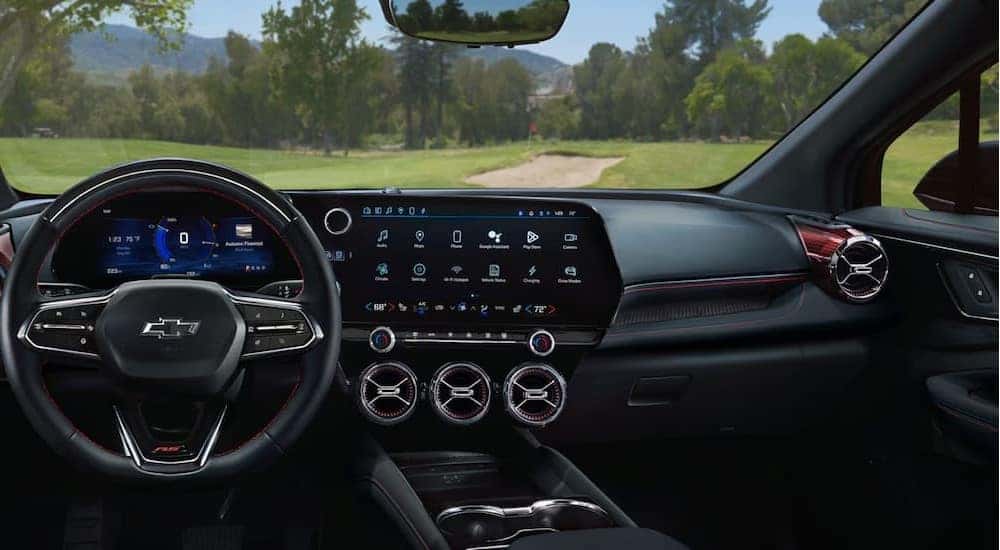
The Blazer and Blazer EV’s differences extend beyond the powertrains. Both the Blazer and Blazer EVs come with modern infotainment centers, although it’s fair to say the regular Blazer’s infotainment center is more traditional in both function and form. The Blazer EV comes with a brilliant 17.7-inch infotainment center that harmoniously blends in beautifully with the digital instrumentation panel that replaces the traditional analog gauges of the Blazer.
Aesthetically, the Blazer’s infotainment center is far more reminiscent of what we expect media hubs to look like in vehicles. The 10.2-inch screen in the Blazer is vibrant, crisp, and has a sleek design, making it one of the better infotainment centers in its class, even if it is smaller than the Blazer EV’s. But the difference extends beyond screen size—some of the software baked into these two models also differs.
With the traditional Blazer, connecting your smartphone gives you full access to wireless Apple CarPlay and Android Auto. In contrast, the 2025 Blazer EV is one of the first models to incorporate Chevy’s new operating system developed by Google. With Google Built-In, the advantage is that you have smartphone features in your car without the requirement to connect an external device.
The 2025 Blazer and Blazer EV: Siblings, Not Clones
Circling back to the beginning of our discussion, we have covered several differences between the Blazer and Blazer EV. Are there any similarities? There are a few. The Blazer and Blazer EV are both midsize SUVs that embrace a sportier aesthetic, and you can expect Chevy’s engineering prowess tucked into every crevice of the cars.
Aside from obvious similarities, the more in-depth ones include identical special editions, with the Midnight and Sport editions providing similar details to enhance the fascia and grille. However, there’s no denying the differences outweigh the similarities between the two SUVs, and the price reflects this. Ultimately, your choice will likely come down to the price and the powertrains—can you afford the Blazer EV, and is the switch to electricity worth it? That’s for you to decide, but we’re here to help you learn a thing or two.